Half a day
Early morning: National Archaeological Museum. Mid-morning: guided visit to Porsenna's Labyrinth and, if included, the bell tower. Lunch in the centre, with pici and Tuscan dishes.
 Podere Sionne
Culture
According to tradition, it was from Chiusi that King Porsenna marched on Rome. Today ancient Clevsin keeps a museum of urns and vases, a labyrinth of tunnels beneath its houses, early Christian catacombs and a few painted tombs in the countryside. The old town is ten minutes from Podere Sionne (Chiusi Città) and is easily visited in a morning. This guide explains what to see, in what order, and how to plan the visits that need booking.
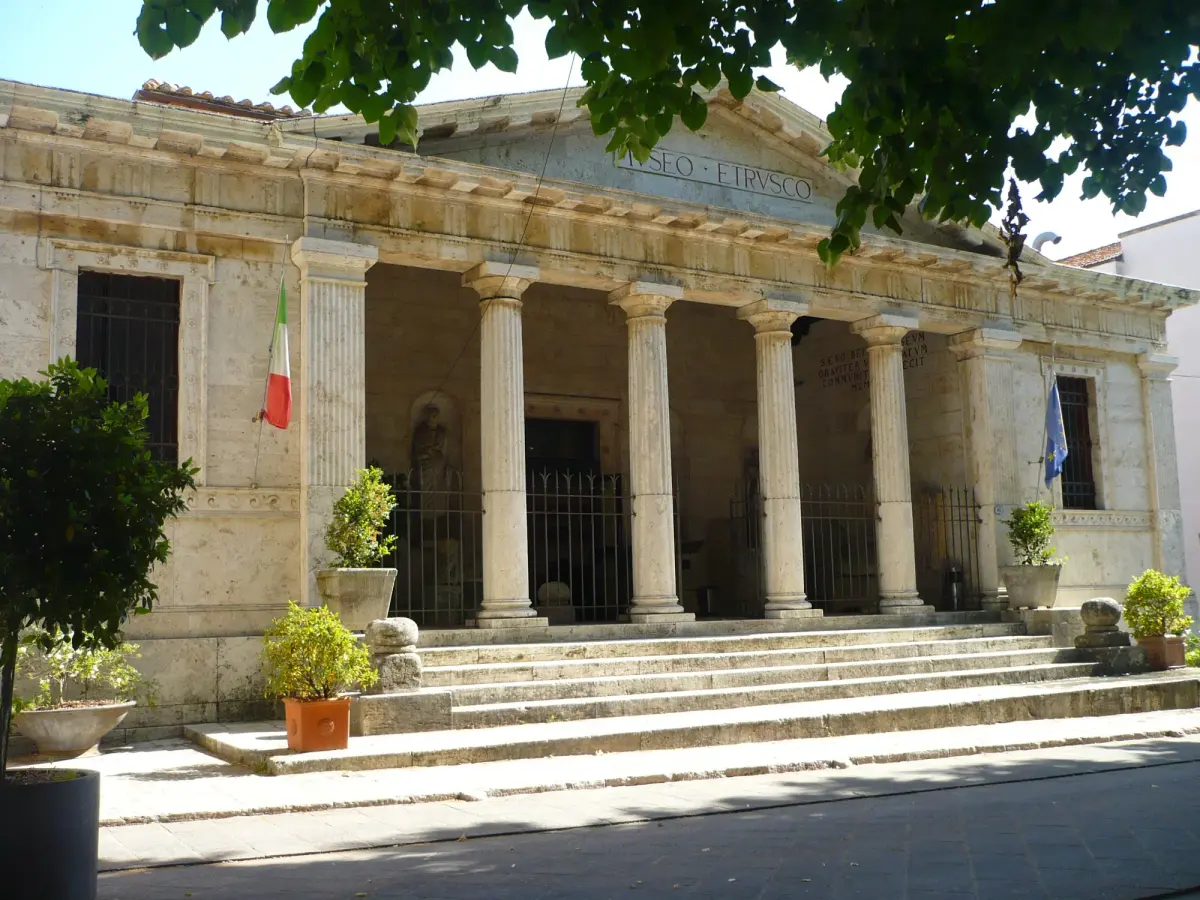
Chiusi, the Etruscans' Clevsin and the Romans' Clusium, was one of the most powerful cities of inland Etruria and, according to tradition, one of the twelve cities of the Etruscan league.
Its most famous king is Porsenna, whom Roman tradition remembers for besieging Rome around 508 BC. Ancient writers describe a monumental tomb of his with a labyrinth: it has never been found, but the legend gives Porsenna's Labyrinth its name.
What survives of that world is mostly its tombs, which is why Chiusi has more urns, vases and grave goods to show than large buildings.
It is the ideal starting point: it gathers finds from the necropolises of the area and is the right place to understand what you will meet underground afterwards.
Opening times and tickets change through the year: check the museum's official website before you go.
Beneath the old town runs a network of tunnels and cisterns dug in Etruscan and Roman times. The guided route starts from the Cathedral Museum and goes underground: it is the most atmospheric part of Chiusi.
Just outside the old town you can visit two early Christian catacombs, dedicated to Saint Mustiola and Saint Catherine of Alexandria: galleries with tombs cut into the walls, seen on a short guided visit.
In the countryside around Chiusi there are a few painted Etruscan tombs. The best known is the Tomb of the Monkey, from the 5th century BC, with scenes of games and contests painted on its walls.
Early morning: National Archaeological Museum. Mid-morning: guided visit to Porsenna's Labyrinth and, if included, the bell tower. Lunch in the centre, with pici and Tuscan dishes.
Morning as above. Afternoon: Tomb of the Monkey by appointment, then a walk by Lake Chiusi. Dinner at the villa, ten minutes from the centre.
Chiusi is a good starting point for other places nearby.
The National Archaeological Museum and Porsenna's Labyrinth with the Cathedral Museum: roughly three hours, lunch not included. With more time you can add the catacombs and a painted tomb.
An underground route of tunnels and cisterns from Etruscan and Roman times, beneath the old town. The name recalls the legend of Porsenna's tomb, which has never been found. It is visited with a guide.
Only with a guide and usually by appointment through the museum: it is best to ask a few days ahead.
The old town, Chiusi Città, is about 10 minutes by car.
The old town is walkable. For the tombs and the surroundings a car is best. By train you arrive at Chiusi-Chianciano Terme station, in the lower part of town.
Spring and autumn, with mild temperatures. In summer go early in the morning; the underground sites stay cool.